DEAL SHOPPING GUIDE
Multipack deals: compare unit price and usable quantity
By Unbeatable Deals · Updated
Quick answer
Divide the total price by the same quantity unit, then ask whether you will use the whole purchase. A bigger pack or larger percentage discount can still cost more per ounce, item or amount you actually need.
01
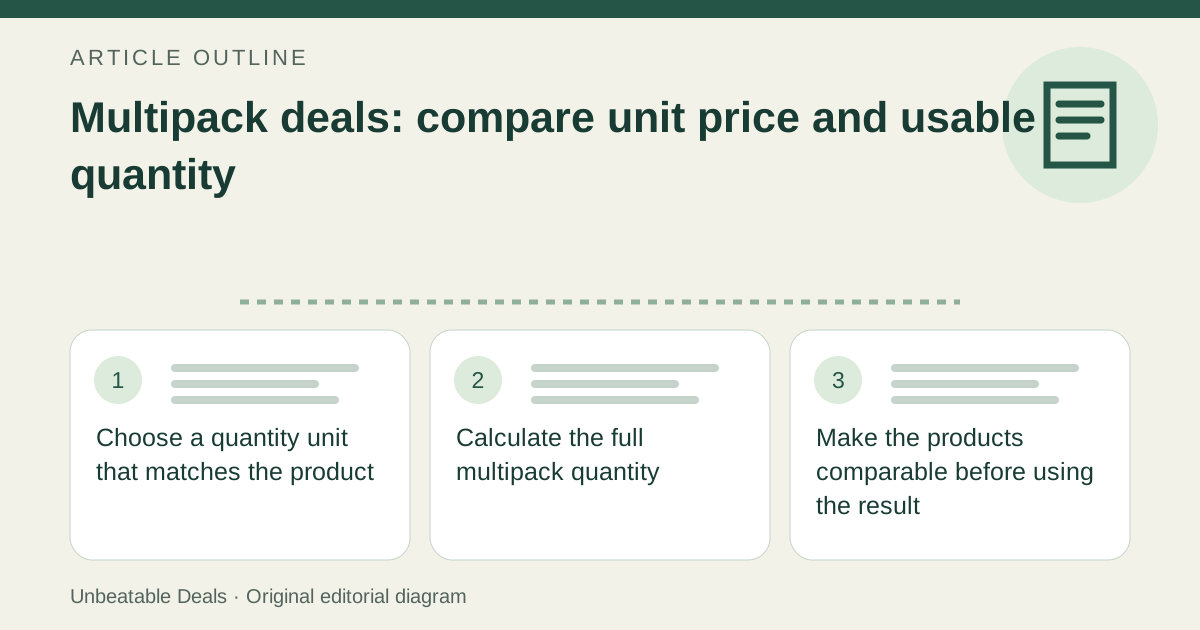
Choose a quantity unit that matches the product
Compare liquids in the same volume unit, dry goods in the same weight unit, and genuinely equivalent individual items by count. NIST recommends consistency across package sizes so unit prices can be compared meaningfully. Do not compare dollars per fluid ounce with dollars per ounce by weight. For mixed bundles, identify the useful components separately; a single price per “piece” can hide that the pieces have different purposes or sizes.
02
Calculate the full multipack quantity
Multiply the number of containers by the quantity in each one before dividing the price. A fictional four-pack of 12-fluid-ounce bottles contains 48 fluid ounces. At $18, that is $0.375 per fluid ounce. A two-pack of 20-fluid-ounce bottles contains 40 fluid ounces; at $14, it is $0.35 per fluid ounce. The smaller purchase costs less overall and per fluid ounce in this example. Keep enough decimal places to compare close results.
03
Make the products comparable before using the result
Check the selected formula, dimensions, material or concentration where relevant. Unit price describes the cost of a quantity; it does not establish equal quality, strength or performance. A paper-product roll count, for example, does not tell you whether the rolls contain the same sheet count or size. Use the stated measurable quantity that answers your comparison and keep any difference in the actual product visible.
04
Include only discounts you can use
Recalculate using your eligible checkout price and required delivery charges. A first-order subscription price, minimum-spend coupon or membership price is a different buying condition from an ordinary one-time purchase. In a fictional example, $18 plus $4 shipping for 48 fluid ounces is about $0.458 per fluid ounce, before tax. Do not use the lower item-only calculation to compare it with a delivered offer. Keep recurring purchases separate from the first shipment.
05
Account for the quantity you expect to use
Check storage space, your rate of use and any relevant expiry or care instructions. For a personal budget, compare the total outlay with the amount you realistically expect to use. If a fictional $24 pack contains 12 equivalent items but you only need eight, the purchase costs $3 per item you expect to use. An $18 eight-pack costs $2.25 on that basis. This is a personal-use estimate, not the package’s official unit price, and it changes if you can use or share the remainder.
06
Notice when a familiar package changes size
Keep the quantity alongside the price when you compare a repeat purchase. NIST describes shrinkflation as a reduction in contents without a corresponding price reduction. A familiar package design or unchanged sticker price can therefore conceal a higher unit price. In a fictional example, $10 for 20 ounces is $0.50 per ounce; $10 for 18 ounces is about $0.556, roughly 11.1% more per ounce. The calculation does not establish why the pack changed.
07
Use a two-number buying rule
Write down both the checkout total and the comparable unit price. Set a maximum total budget first, then choose among quantities you can use and products that meet your requirements. This prevents a lower unit price from turning a small planned purchase into unnecessary spending. If quantity, variant or eligibility is unclear, leave the comparison unfinished until it is confirmed. All worked examples here are fictional and do not describe current retailer offers.
Sources
- NIST: Unit Pricing Guide, 2025 edition — consistent units and package quantities
- NIST: uniform unit pricing and shrinkflation
See how we check deals for this site’s reference-price and freshness policy.
Browse Home essentials deals, or browse current deals with this checklist. Report unclear guidance through corrections.